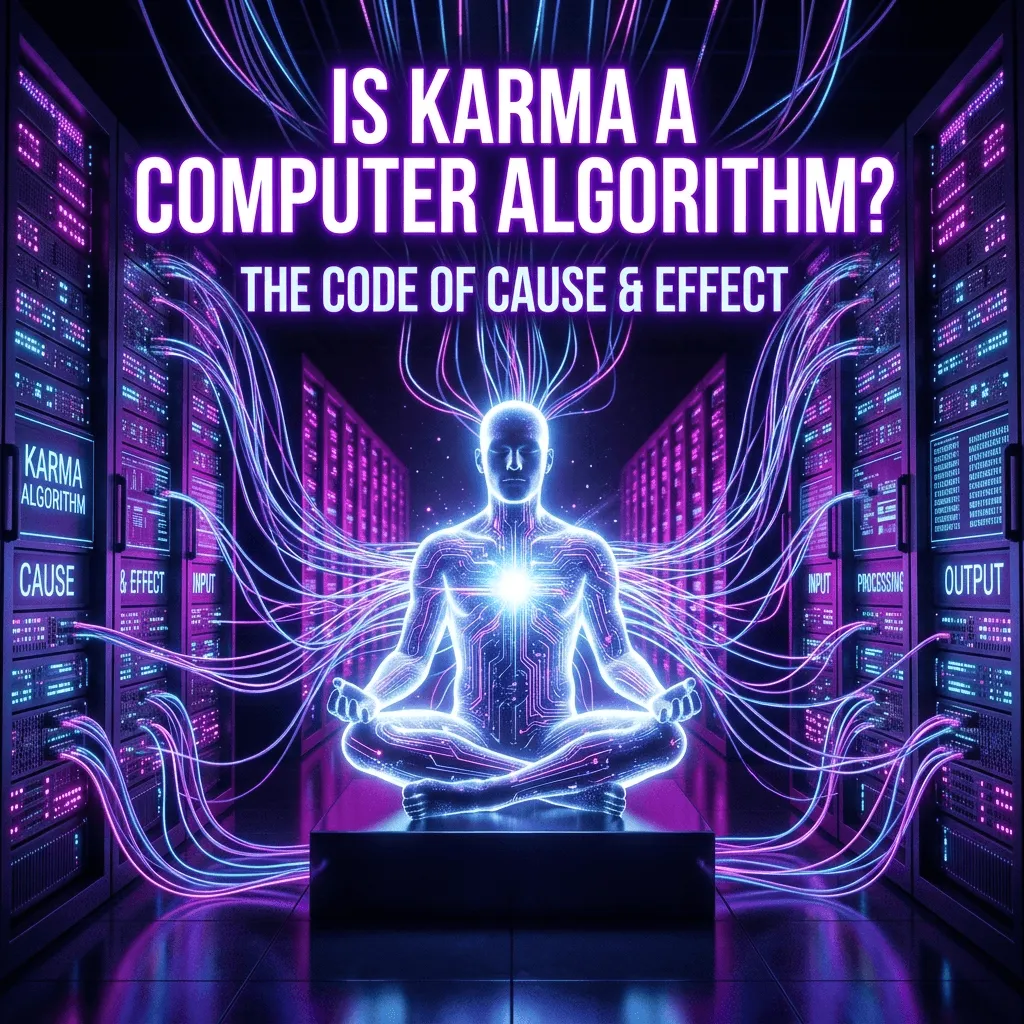
Karma is often misunderstood as a mystical cosmic ledger—a magical force that punishes the wicked and rewards the righteous. But what if karma isn't magic at all? What if it's just a fundamental law of systems engineering?
As a polymath bridging the gap between computer science and spirituality, I've come to realize that Karma is simply a deterministic state machine operating at scale.
Let's break down the spiritual concept of Karma using the mental models of Computer Science.
1. The Universe is a State Machine
In computer science, a Finite State Machine (FSM) is a computational model consisting of a set of states, a start state, and transitions between those states based on inputs.
Your life is a state machine. Your current reality—your relationships, your bank account, your physical health, your peace of mind—is the Current State.
Every action you take, every word you speak, and even every thought you harbor acts as an Input.
// A simplified model of Karma
function applyKarma(currentState, action) {
    const nextState = computeTransition(currentState, action);
    return nextState;
}
Karma dictates that the transition from currentState to nextState is purely deterministic based on the action. If you consistently input negativity, deception, or greed, the function computeTransition mathematically guarantees a lower-quality nextState. There is no cosmic judge; it is simply the deterministic execution of the universe's codebase.
2. Eventual Consistency and "Delayed Karma"
A common complaint about karma is: "Why do bad things happen to good people? Why do bad people succeed?"
In distributed systems design, we have a concept called Eventual Consistency. When you update a massive database (like the universe), the change doesn't instantly propagate to all nodes. For a brief period, if you read from a different node, you might get old, stale data. But eventually, the system synchronizes and achieves consistency.
Karma is an eventually consistent system.
When someone acts unethically to get ahead, they are exploiting a temporary synchronization delay in the system. They appear to be winning in the short term (the stale read). But the ledger of the universe is distributed, and the synchronization is inevitable.
- The unethical shortcut creates hidden tech debt in their life.
- The tech debt compounds.
- Eventually, the system reconciles, and the debt is called in.
The delay isn't a failure of justice; it's just the latency of a highly complex, distributed network.
3. The Butterfly Effect and Graph Theory
Graph theory teaches us about nodes (entities) and edges (connections). The universe is a massive, fully connected graph.
When you perform an action (a perturbation at your node), the energy of that action traverses the edges of the graph. Because human interactions are highly clustered, the graph contains countless cycles (loops).
What this means mathematically is that a signal sent out into the network is highly likely to traverse a cycle and return to the origin node.
"As you sow, so shall you reap" is not a threat. It is a literal description of signal propagation in a cyclic graph network.
4. Refactoring Your Karma (Tech Debt)
If you have a history of bad decisions, you have accumulated Karmic Tech Debt.
In software engineering, you can't just ignore tech debt. The longer you wait, the harder it is to fix, until eventually the entire application grinds to a halt. The only way out is to stop writing bad code and start intentionally refactoring the old code.
In spiritual terms, this means:
- Stop adding new bugs: Commit to ethical actions and mindfulness (pure inputs).
- Refactor the legacy code: Apologize, make amends, and practice forgiveness. You are rewriting the broken transitions in your personal state machine.
Conclusion: The Ultimate Algorithm
Spirituality and Computer Science are not opposing forces; they are two different languages describing the exact same underlying reality.
Karma isn't a judge sitting on a cloud. It is the uncompromising, beautiful, deterministic algorithm that governs the graph network of human existence.
Write good code. Make good choices. The compiler of the universe is always watching.